
New U.S. sanctions targeting parts of Iran's transport and financial infrastructure have widened the restrictions surrounding trade with the world's largest saffron-producing country.
On 1 October 2026, the U.S. Department of the Treasury announced new sanctions targeting Iran's rail sector, including several major railway companies. On the same day, Treasury took separate action against the A7 Network, a shadow-banking network with ties to Russia that U.S. authorities say has also been used by Iranian actors to evade sanctions and move funds through the international financial system.
For saffron buyers, however, there is an important distinction:
Saffron itself has not been specifically targeted by these new sanctions.
The relevance to the saffron industry is instead about the wider environment in which Iranian goods are transported, traded and paid for internationally.
What Changed?
The U.S. Treasury expanded sanctions targeting Iran's rail and automotive sectors under Executive Order 13902.
Among the rail companies targeted were the state-owned Islamic Republic of Iran Railway Company, Raja Passenger Trains Company and other companies involved in Iran's rail and freight network.
As maritime trade routes have come under greater pressure, Iran has increasingly relied on land transportation, making its rail network more important for domestic freight and regional trade.
The sanctions do not mean that all goods transported by Iranian rail are automatically prohibited everywhere. Rather, they increase sanctions exposure around designated companies and certain transactions involving them.
A separate Treasury action targeted the A7 Network, which U.S. authorities say has been used to disguise sanctioned or illicit payments as ordinary commercial transactions. Treasury said parts of the network had also been used in connection with Iranian oil sales and procurement activities.
Together, the measures increase the regulatory and compliance pressure surrounding some of Iran's transport and financial networks.
Is Iranian Saffron Now Sanctioned?
No — the 1 October measures do not specifically designate saffron as a sanctioned product.
This is an important distinction.
A sanction affecting a railway operator, financial network or industrial sector is not the same as a prohibition on an agricultural commodity.
The immediate saffron story is therefore not that Iranian saffron has been banned.
Instead, the question is whether increasing restrictions surrounding transportation, payments and international counterparties could make some aspects of Iranian trade more complicated.
At this stage, the available evidence does not establish that the latest sanctions have reduced saffron exports or availability.
Why Iran Matters to the Global Saffron Market

Iran's importance to saffron makes developments affecting its trade infrastructure particularly relevant.
The Food and Agriculture Organization of the United Nations (FAO) reported in 2025 that Iran produces more than 90% of the world's saffron. Iran is therefore central to the wider picture of where saffron comes from, alongside producing regions such as Spain, India, Greece and Afghanistan.
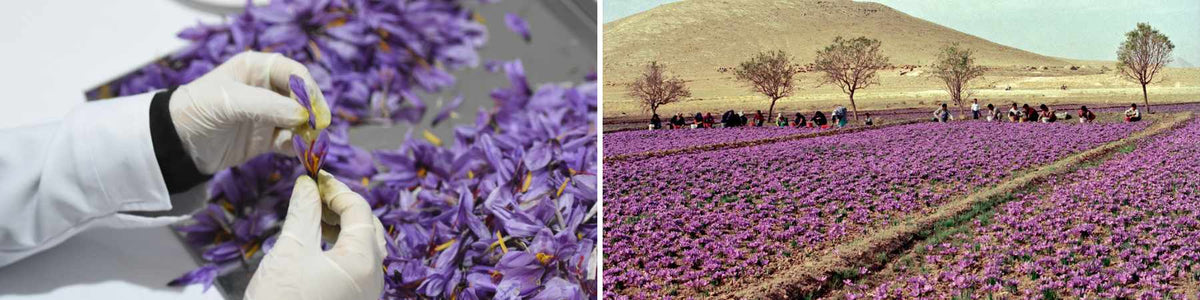
Saffron cultivation is particularly important in Iran's main producing provinces of Khorasan Razavi, North Khorasan and South Khorasan, and the crop plays an important role in farmers' livelihoods and national trade.
That concentration means developments affecting Iran can attract attention well beyond the country itself.
However, a large share of global production does not mean every change to Iranian trade infrastructure will automatically affect saffron buyers. The actual impact depends on how saffron moves through the supply chain, the businesses and intermediaries involved, destination-country rules and the payment channels being used.
What Could the New Sanctions Mean for Saffron Buyers?
For now, the most accurate answer is: this is a development to watch rather than evidence of an immediate supply problem.
Businesses dealing with Iran already operate within a complex international sanctions environment. Additional restrictions involving transport companies and financial networks can add further compliance considerations for importers, exporters, banks and other intermediaries.
But there is currently not enough evidence to conclude that the 1 October sanctions will:
- reduce global saffron supply
- create a saffron shortage
- increase saffron prices
- prevent Iranian saffron from reaching international markets
Those outcomes would require separate evidence.
What the latest measures do show is that the environment surrounding Iranian international trade continues to change.
Why This Matters to Saffron Buyers
Saffron has an unusually concentrated production base, which makes transparency across the supply chain particularly important.
Knowing where saffron was grown is only one part of that picture. International saffron can pass through exporters, processors, distributors and trading centres before reaching the final buyer. Production, processing, quality and market conditions can all influence the factors affecting saffron's value, so it would be too simplistic to assume that a new sanction will automatically translate into a particular retail price movement.
Developments affecting transportation and financial networks in the world's dominant producing country are therefore worth monitoring — even when saffron itself is not the target.
For buyers, the key is to distinguish between confirmed changes to the trading environment and speculation about what those changes might eventually mean for supply or price.
Given Iran's importance to global saffron production, developments affecting the country's transport and financial infrastructure are worth following. For now, however, there is not enough evidence to say that the latest measures are materially affecting global saffron availability or prices. The more useful approach is to follow verified changes in trade flows and supply conditions rather than assume that broader geopolitical pressure will automatically translate into shortages.
References
U.S. Department of the Treasury. Operation Economic Outcast Targets Iran's Remaining Industrial Lifelines. 1 October 2026.
U.S. Treasury source
U.S. Department of the Treasury. Operation Economic Outcast Takes Unprecedented Action Against Sanctions Evasion Network Used by Iran. 1 October 2026.
U.S. Treasury source
Reuters. US sanctions target Iran's auto, rail sectors as blockade chokes ship lanes. 1 October 2026. Reuters
Food and Agriculture Organization of the United Nations. FAO signs agreement with Mashhad University to advance saffron authenticity testing methodologies. 16 September 2025.
FAO source